

A worked example: Whitfield Residence
Day 35 of a 90-day rear extension, walked through record by record: the enquiry it came from, the quote it was priced at, the contract, the variation, the invoices, the CIS month and what it is actually costing.
Updated 18 September 2026
This is the demo project, not a customer
Everything below is the sample job that ships with SiteScope's demo seed — a realistic composite, not a real household. Nobody's name here belongs to a real client, and nothing is a testimonial. Run the demo seed and you can click through every record described.
The point of walking through one job in this much detail is that it shows what SiteScope looks like when it is being used properly: not the feature list, but the actual state of a job halfway through, and what that state does for you.
The job
| Builder | Mason & Co Builders, Guildford — FMB member, two staff |
| Job | Whitfield Residence — Rear Extension (ref MC-2026-014) |
| Scope | Single storey rear extension: bi-fold doors, vaulted ceiling, new kitchen |
| Site | 14 Orchard Lane, Guildford |
| Came from | A referral from a previous client, 75 days ago |
| Contract sum | £68,000 net, £81,600 including VAT — plus £1,450 of approved changes |
| Programme | 90 days. We are looking at day 35 |
| On it | Alex Mason (owner), Jamie Carter (site carpenter), Sam Whitfield (client) |
Three people, one job, one system. Alex sees everything. Jamie sees the work. Sam sees his own house being built, the price he agreed and the decisions waiting on him — and nothing else: not what the job costs Mason & Co, not the diary, not the hours.
Before it was a job
Seventy-five days ago the phone rang. The Ramans, whose loft conversion Mason & Co were finishing up the road at the time, had passed Alex's number on. That call is a row: name, what they wanted, where they heard about it, and a ballpark of £65,000 — thirty seconds while Sam was still on the line.
Alex rang back the next morning, went out three days later, and the visit record is still there: the patio is coming up and is not being replaced, the drains run along the boundary so there will be a build-over agreement, and the opening measured 4.2m by 6.0m. That is the sort of detail nobody writes down and everybody needs eight weeks later.
The price, built up from what the work costs
The quotation — QUO-0002 — was priced line by line from Mason & Co's own costs: groundworks, steels, blockwork, roof, bi-folds, carpentry, M&E, plastering, an allowance for the kitchen, and the scaffold. £54,400 of cost in total.
| Cost of the work | £54,400 |
| Margin | 20% |
| Price | £68,000 — the cost divided by 0.8, which is a 25% markup |
| VAT at 20% | £13,600 |
| Total to the customer | £81,600 |
Twenty per cent margin is not twenty per cent on top
Adding 20% to £54,400 gives £65,280 and leaves a margin of 16.7%. Taking a 20% margin means dividing by 0.8, which gives £68,000. On this one quote the difference is £2,720 — and it is the commonest arithmetic mistake in the trade, which is why the estimator shows both numbers side by side as you price.
Two lines on it are doing quiet work. The kitchen units are a provisional sum — an allowance of £6,000, not a price — so when Sam picks his units the figure moves and nobody is surprised. And taking up the existing patio is written in as excluded, because "I assumed that was included" is what the argument at the end of a job is always about.
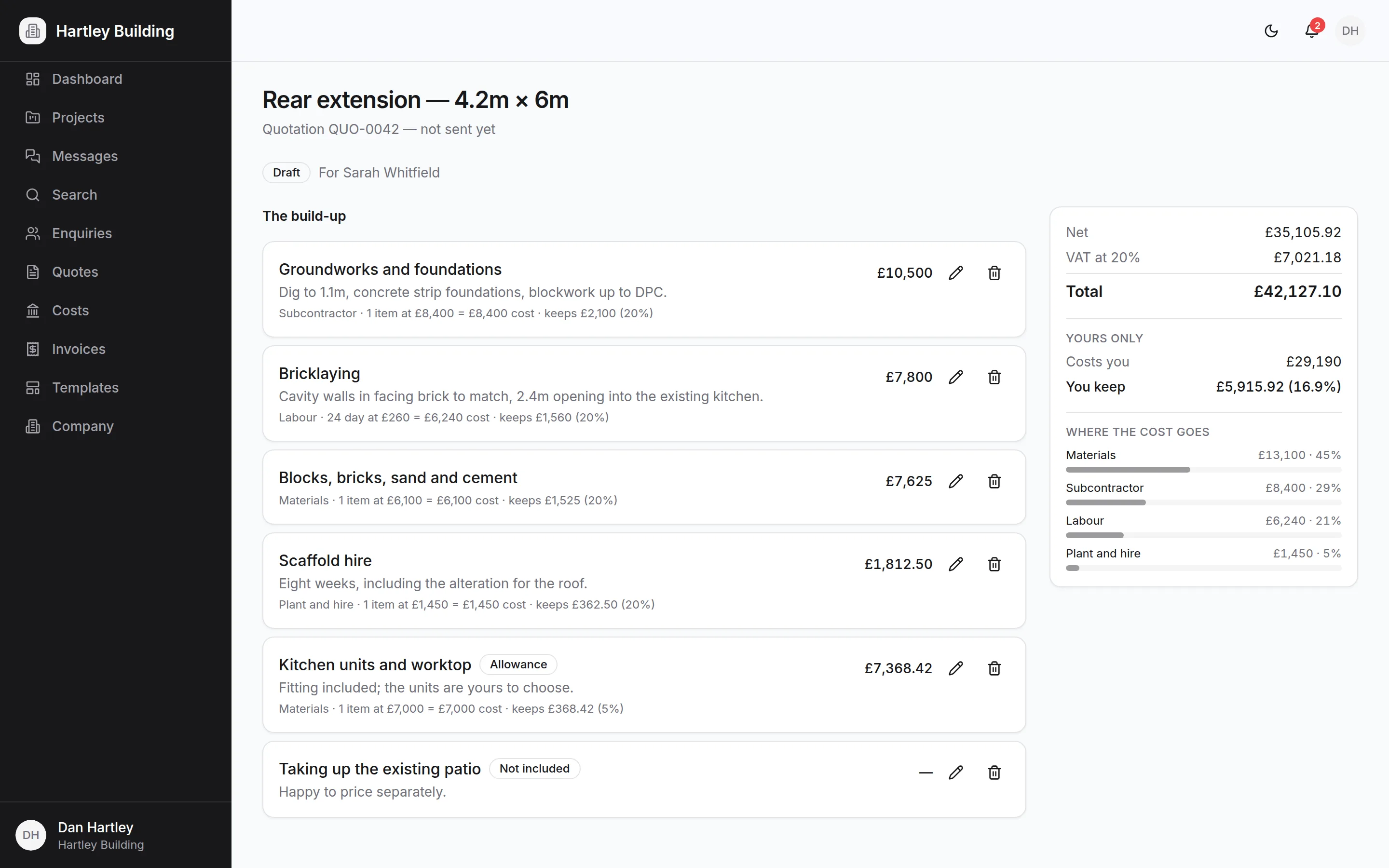
Sam accepted it six days later, and that is the moment the job started itself. The contract sum, the VAT rate and the full scope of works — including the exclusion and the provisional sum — were written onto the project from the quote. Nobody retyped a line, which is why the figures on the Money tab and the figures on the quotation are the same figures rather than two copies that agree for a while.
Where the programme is
Five stages, generated from the Single Storey Extension template on day one and adjusted since.
| Stage | Status | Done |
|---|---|---|
| Pre-construction | Completed | 100% |
| Groundworks & Foundations | Completed | 100% |
| Superstructure | In progress | 55% |
| First Fix | Not started | 0% |
| Decoration & Completion | Not started | 0% |
Groundworks finished two days ahead of its target date, which is visible because the stage carries both a target and an actual end date. That is a fact worth having when the next stage slips.
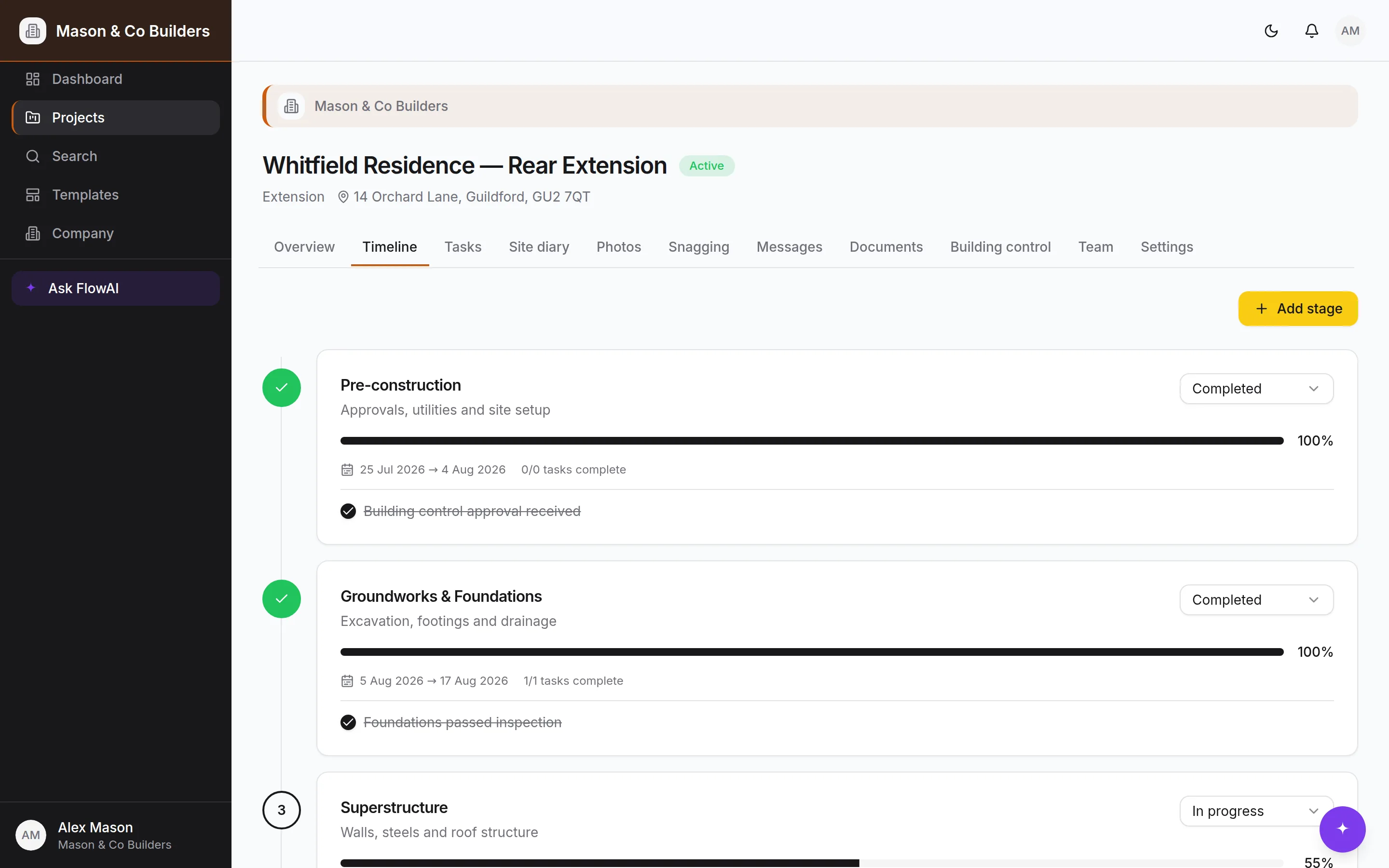
Four milestones, two hit: building control approval received, and foundations passed inspection. Two ahead: watertight shell complete in ten days, practical completion in fifty-five. Sam sees all four — they are the dates that mean something to him.
The work in front of them
| Task | Status | Who | Due |
|---|---|---|---|
| Install structural steels | In progress · High | Jamie | in 3 days |
| Order kitchen units | Awaiting review · Medium | — | in 5 days |
| Build masonry to wall plate | To do · Medium | Jamie | in 8 days |
| Pour concrete foundations | Completed | Jamie | done, 2 days early |
The steels task carries a two-item checklist: fabrication drawings approved (ticked four days ago) and delivery date confirmed with supplier (not ticked). That single unticked box is the actual risk on this job right now — the whole superstructure stage waits on the steels, and the steels wait on a phone call.
Which is exactly what FlowAI surfaces
Asked "what's left before we can book the pre-plaster inspection?", it comes back with the three open tasks and flags that the delivery-date checklist item is not ticked. It found that by reading the checklist, not by being told it mattered.
"Order kitchen units" sitting at awaiting review is the other thing to notice. It is not late and nobody is failing to do it — it is waiting on Sam confirming the final design. Left as "to do" it would look like Mason & Co's problem. Marked awaiting review, it shows on Sam's dashboard as a decision waiting on him.
The variation, handled
Two days ago this happened in the project thread, in four messages:
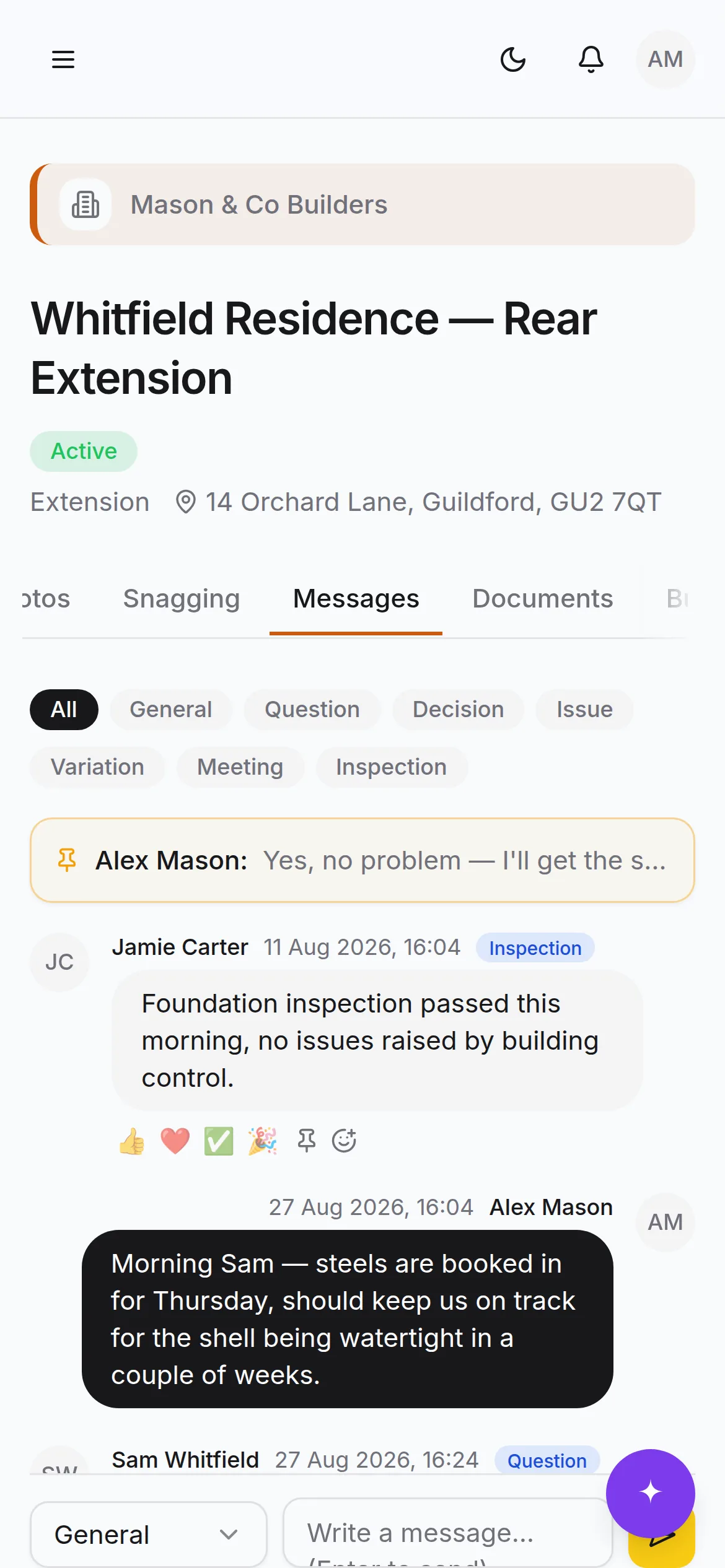
- 1.Alex, general: "Morning Sam — steels are booked in for Thursday, should keep us on track for the shell being watertight in a couple of weeks."
- 2.Sam, question: "Great news! Quick one — can we still fit the wider bi-fold door (4 panel instead of 3)?"
- 3.Alex, decision — pinned: "Yes, no problem — I'll get the steel lintel width confirmed with the structural engineer to make sure the opening works. Will update the drawings."
- 4.Jamie, inspection (eighteen days ago): "Foundation inspection passed this morning, no issues raised by building control."
This is the sequence that, on a job run over WhatsApp, becomes a dispute in month four. Here, three things make it safe:
- It is categorised. Alex's reply is filed as a *decision*, not general chat, so it is findable by category rather than by scrolling.
- It is pinned. It stays at the top of the thread for the rest of the job.
- It is timestamped and attributed, in an audit trail nobody can edit — including Mason & Co.
The lintel change also has to reach the structural engineer and the drawings, and neither of those is automatic. What SiteScope guarantees is that in eight weeks, when the opening is built and somebody asks who agreed to a four-panel door, the answer takes ten seconds.
The money, on day 35
The four-panel door is not just a pinned message. It is VO-001: £1,450, three days on the programme, sent to Sam and approved by him in the app two days ago with his name and the timestamp against it. Until he answered, it was not in the contract sum. Now it is, and the headline figure says £69,450 to both of them.
There is a second change sitting with him — anthracite rainwater goods, £340 — and the Money screen says so in one line rather than leaving it in somebody's head.
| Stage | Net | Where it is |
|---|---|---|
| Deposit | £6,800 | Paid — invoiced on acceptance, in the bank |
| Foundations complete | £17,000 | Invoiced ten days ago, four days overdue |
| Watertight shell | £17,000 | Falls due when the milestone is ticked |
| First fix complete | £13,600 | Due on a date, next month |
| On completion | £13,600 | The balance |
| Approved changes | £1,450 | The four-panel bi-fold |
Two of those are tied to milestones rather than to dates, which is the difference between a stage falling due because the work is signed off and a stage falling due because somebody remembered to ask. When the foundations milestone was ticked, the £17,000 became due by itself.
£170 of retention is held so far — 2.5% of what has actually been paid, not of the contract — and it is released in two halves: one at practical completion, one at the end of the defects period. Neither of those is a conversation; both are dates.
What it is costing
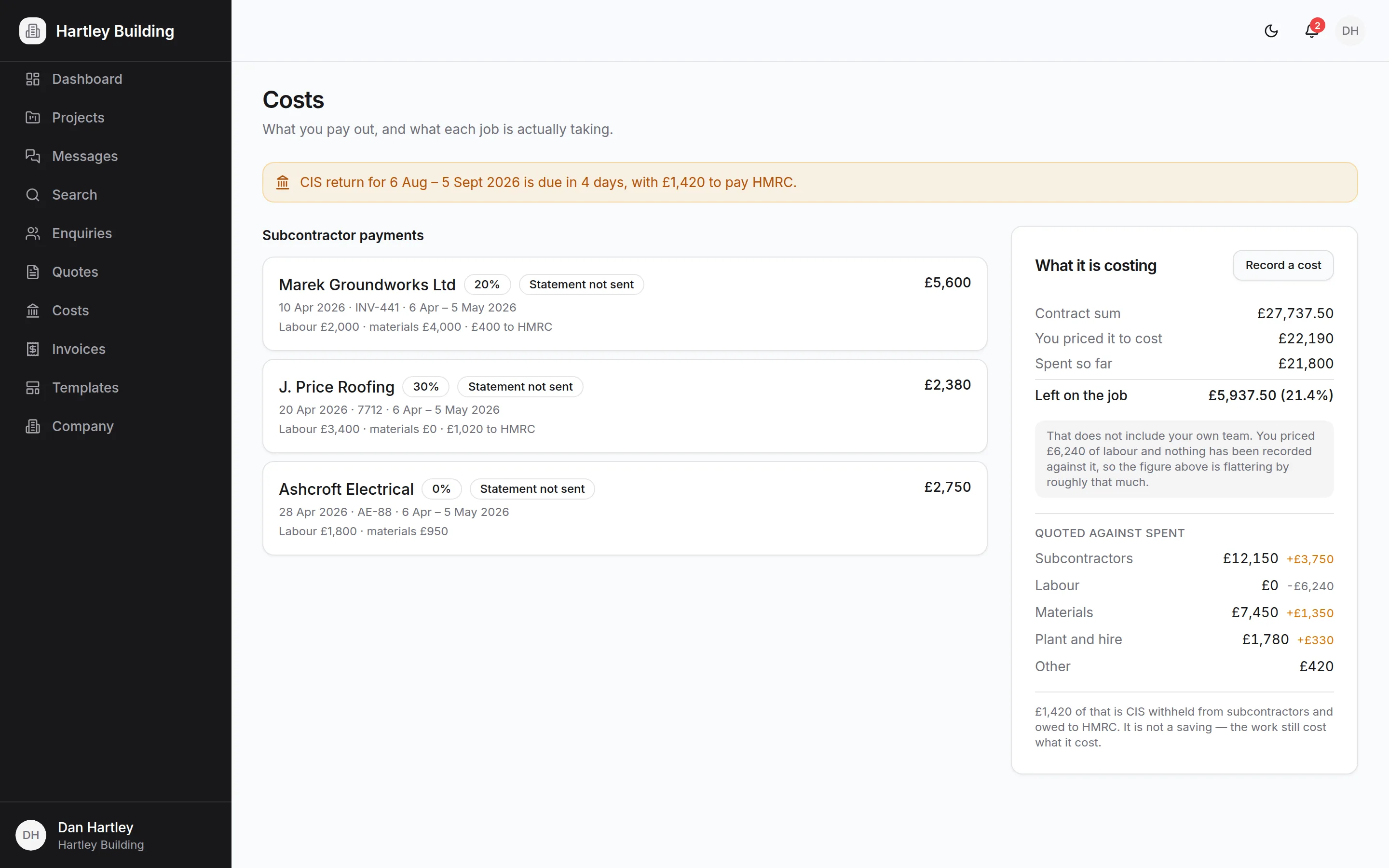
Against £54,400 of quoted cost, £23,650 has gone out so far: four subcontractor payments and four purchases, scaffold and skips included. The screen puts them next to the build-up the quote was made from, kind by kind — and it says plainly that £17,600 of quoted labour has no time recorded against it, so the margin on screen is flattering by roughly that much. A number that lies in your favour is worse than no number.
The CIS month
Marek Groundworks is verified at 20% and J. Price Roofing came back unmatched, so he is on 30% until he sorts his registration out. Ashcroft Electrical has gross status and nothing is withheld. Each rate was snapshotted onto the payment when it was made, so a payment made at 30% still says 30% after that subcontractor gets verified at 20% — which is what the return already filed says, and what his statement says.
The deduction comes off labour only. Marek's £3,200 payment was £2,000 of labour and £1,200 of materials: £400 to HMRC, not £640. For the tax month just ended there is £1,420 to pay over, the return is due on the 19th, the payment on the 22nd, and two subcontractors are still owed their statements. All of that comes out of the payments themselves rather than being typed anywhere.
The unverified subcontractor
Delgado Plastering is in the book and has not been paid, because the database refuses to record a payment to a subcontractor who has not been verified. There is no right deduction until HMRC has been asked — they may be gross, they may be 20%, and if they cannot be matched the answer is 30%. Guess wrong downwards and HMRC comes to the contractor for the difference, not to the subcontractor.
Choices with a date on them
Three decisions are logged against the job. The bathroom tile is chosen. The bi-fold colour is drafted and not yet asked for. The kitchen worktop — quartz at £1,850, oak at £980, laminate at £420 — was needed two days ago and is still with Sam, which matters because the quartz is a six-week lead time and first fix carpentry starts in three weeks. It is on his dashboard and on Alex's, and it is the reason the job will or will not slip.
The paperwork that bites
Sam is a domestic client, so under CDM 2015 his duties pass to Mason & Co as the contractor. The construction phase plan was issued two days before work started — the one date an inspector asks about — and both Alex and Jamie have signed it. Ninety days with six on site at peak is over the F10 threshold, so the notification reference sits on the project.
Three risk assessments are in force on this job: working at height and excavations, both taken off the company library, and one written for the steel lift specifically. Two toolbox talks have been delivered and signed. One signature is outstanding — Alex has not signed the steel assessment he wrote — and the safety screen says so rather than rounding it to fine.
Two incidents are on the log. A scaffold board left across an open trench was a near miss, and the trench is covered properly now. A slip in the side passage put Dave off work for nine days, which is over the seven-day RIDDOR threshold, so it was reported inside the fifteen days with the reference on the record. Neither of those is comfortable reading. Both are the reason the log exists.
The record being built underneath
Site diary
Two entries, both written from a phone at the end of the day.
- Yesterday — overcast, 14°C. Jamie and Dave Ellis, eight hours each, sixteen total. Continued blockwork to first lift, set out steel bearing points. Steel delivery confirmed for Thursday.
- The day before — light rain, 11.5°C. Six hours each, twelve total. Morning lost to rain, blockwork resumed after lunch. Issue logged: weather stoppage 8am–12pm.
That weather stoppage is four hours of a 90-day programme, and it took ten seconds to record. It is also precisely the kind of thing nobody can evidence six weeks later when the completion date is being argued about. Diary entries cannot be edited after the fact, which is what makes them worth anything, and Sam cannot see any of it.
Building control
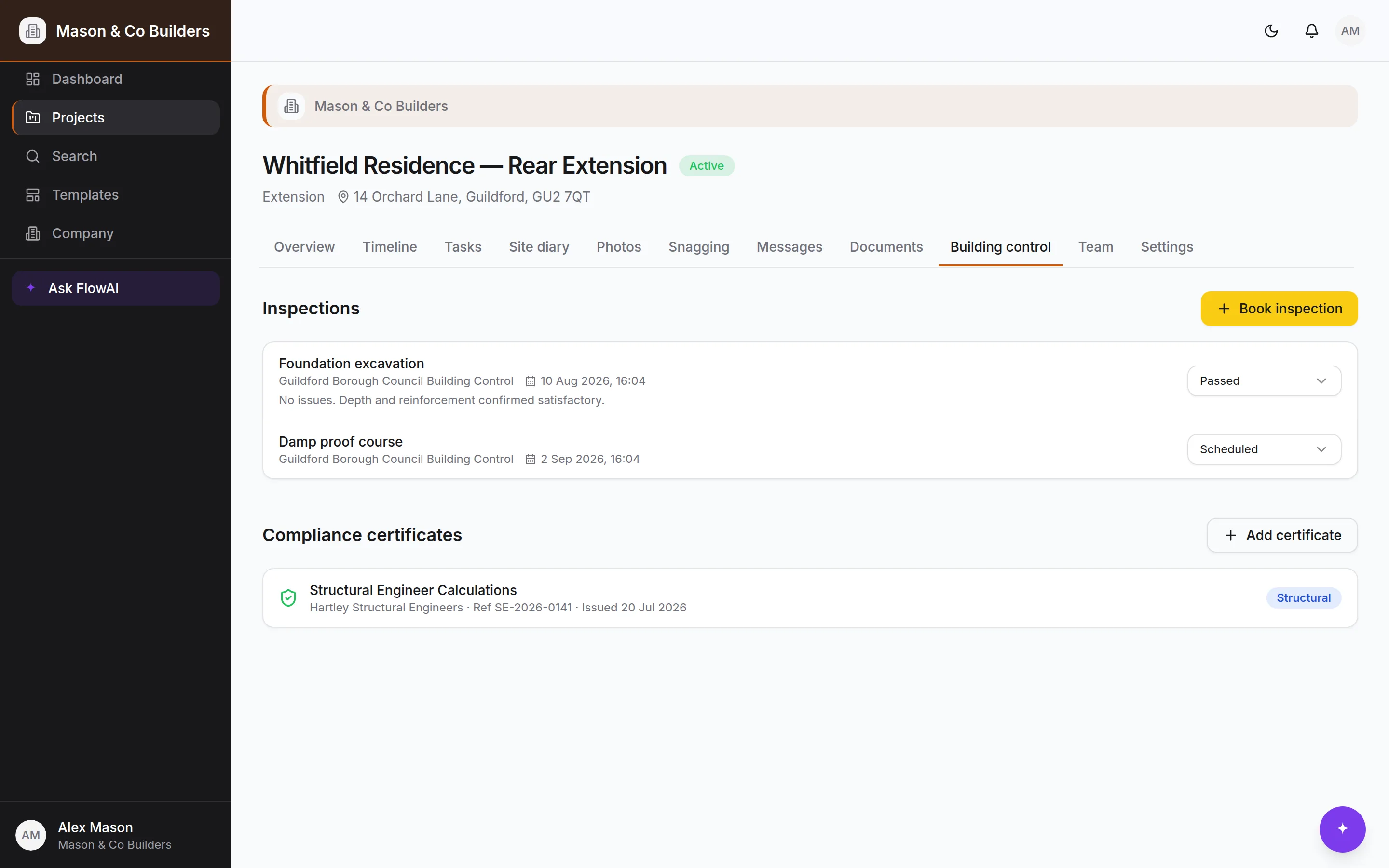
- Foundation excavation — passed, Guildford Borough Council Building Control. "No issues. Depth and reinforcement confirmed satisfactory."
- Damp proof course — scheduled, in four days.
Compliance
One certificate on file: Structural Engineer Calculations, ref SE-2026-0141, Hartley Structural Engineers. More will land as the job goes on — electrical, gas, energy — and each goes into the same place.
Snagging, already
Two snags, both raised by Sam, both well before the end of the job — which is the sign of a client who has been given a way to report things rather than saving them up.
| Snag | Room | Status | Who |
|---|---|---|---|
| Scuff mark on hallway skirting | Hallway | Open | Unassigned |
| Gap under utility room door | Utility | Waiting approval | Jamie |
The second one is the lifecycle working: Sam raised it, Jamie was assigned, Jamie resolved it yesterday, and it is now back with Sam to confirm. When he does, it closes with both names and both timestamps on it. Neither will be a surprise on the final walk-round.
What Sam actually sees
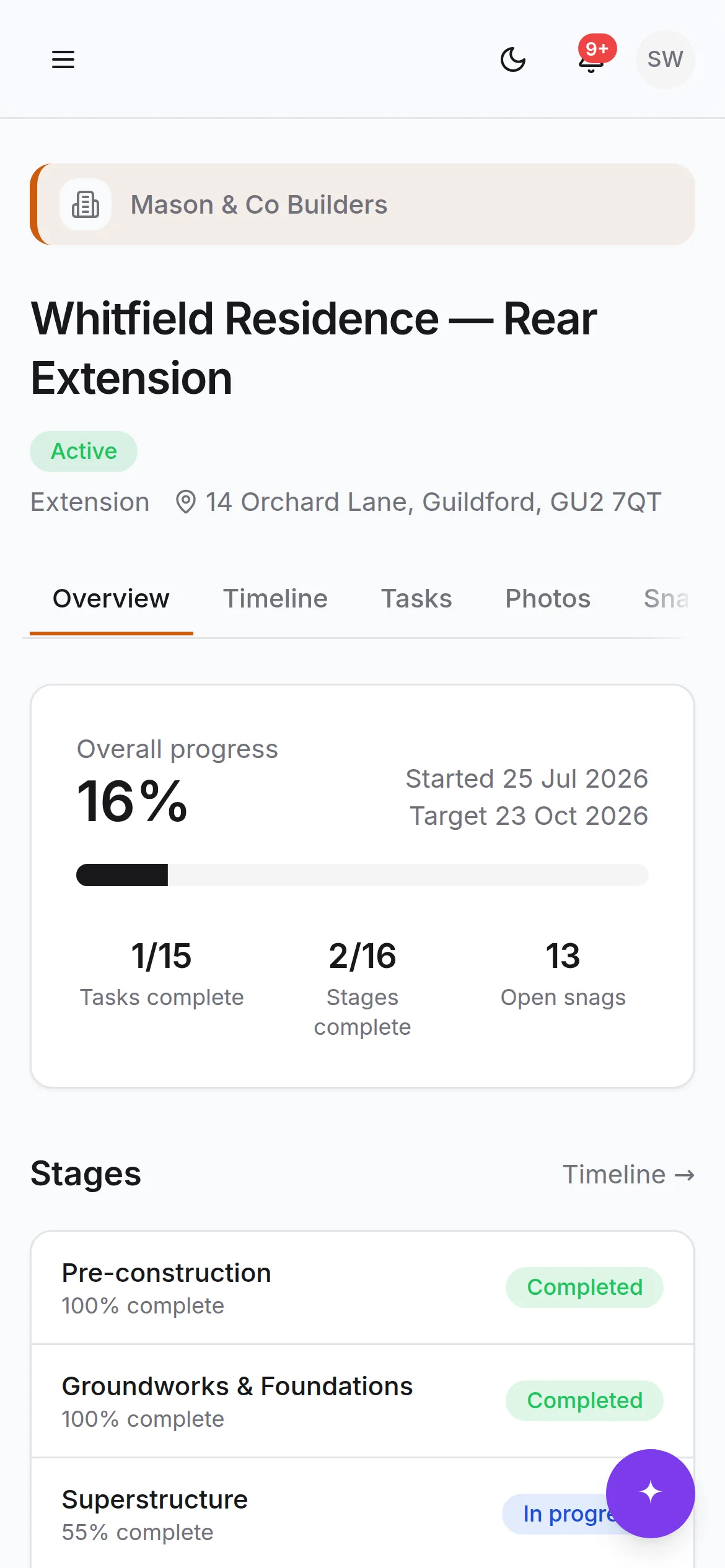
Overall progress, the five stages with their status, his four milestones, the photos, the thread, his two snags, and the kitchen decision waiting on him.
He also sees the money: £69,450 including the change he approved, £6,800 paid, £17,000 awaiting payment, and the next stage with a date on it. What he does not see is the other half of it — that the job was priced from £54,400 of cost, that £23,650 of that has been spent, what any subcontractor was paid, the sixteen hours Jamie and Dave put in yesterday, the weather stoppage, or Mason & Co's notes about anything. All of that is refused at the database rather than hidden in the interface — the distinction matters, because it holds outside the app too.
Where this job ends up
In fifty-five days, when practical completion is signed off, the handover pack is one click. It will already contain the timeline as it actually ran, both hit milestones and the two to come, the certificates, the inspection results, the closed snag list with Sam's confirmations, the spec book, and the completed photographs.
None of that gets assembled at the end. It exists because of two minutes a day for ninety days.
For what that looks like, there is a second job in the demo: the Ramans' loft conversion — the one that sent Sam to Mason & Co in the first place — finished forty days ago.
Forty days after handover
Practical completion was certified on the day of the walk-round, and certifying it did four things at once: the job closed, the defects period started, the first half of the retention fell due, and Priya got somewhere to report anything she finds.
| Contract sum | £42,000 net, from quotation QUO-0001 |
| Retention at 5% | £2,100 — £1,050 released at completion, £1,050 at the end of the period |
| Defects period | 12 months, ending in about ten months' time |
| Reported since | Four things, three of them settled |
The extractor fan was a failed unit, replaced under the manufacturer's warranty. The Velux leak was the roofer's flashing, fixed and recorded against that subcontractor — ours to Priya, his to us. A shrinkage crack above the stair bulkhead is booked in for next week. And a scratch on a windowsill was declined, with the reason written down: it is not on the completion photographs and the sill was signed off on the walk-round, but Mason & Co have offered to make it good at cost.
A defects period is not a limitation period
The twelve months is the window in which Mason & Co come back and put things right as a matter of course. It does not end their liability: under the Consumer Rights Act 2015 a client in England or Wales has six years to bring a claim for faulty work, five in Scotland, and no guarantee shortens that. SiteScope says so on the screen rather than letting the twelve months look like the whole answer.
Three warranties are on file with their expiry dates — the Velux units for ten years, Mason & Co's own workmanship guarantee for two, and Ashcroft's Part P certificate — so when somebody rings in month eleven the answer is in one place rather than in a drawer.
See it for yourself
Every record on this page is in the demo seed: supabase/migrations/0005_demo_seed.sql for the job itself, and 0042_demo_seed_the_whole_job.sql for the enquiries, quotes, contract, invoices, safety file, CIS and the finished loft. Run both against your own Supabase project, in that order, then 0054_sitescope_internal_names.sql, which gives the demo logins their addresses.
Then sign in as demo.builder@sitescope.kudu-digital.com to see all of it, demo.employee@sitescope.kudu-digital.com for what the site sees, demo.client@sitescope.kudu-digital.com for Sam's half-built extension, or demo.client2@sitescope.kudu-digital.com for Priya's finished loft and its defects period. The password for all four is in the header of the first seed file.
The seed writes drafts and then presses the buttons
It does not insert a sent quote, an approved variation or an issued construction phase plan directly — the database refuses all three, which is what makes those records worth anything. It creates drafts and then calls the same functions the app calls, as the builder and as the client in turn, so everything on this page is a state the application could actually have produced.
Still stuck?
- 1Ask FlowAI in the app — it has read these pages. Pro and Bespoke.
- 2Common problems, solved.
- 3Email support.sitescope@kudu-digital.com. We reply within two working days.